
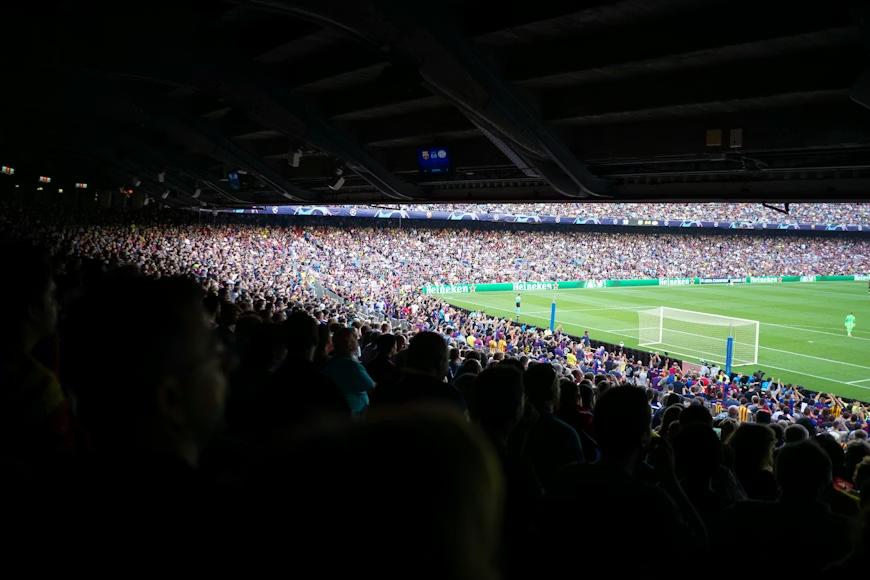
The Champions League standings represent the culmination of 36 elite European football clubs competing in a revolutionary single-league format, where each team plays eight matches against different opponents to secure their position in the tournament hierarchy. As of December 2025, Arsenal leads the league phase with a perfect 18-point haul from six unbeaten matches, while the battle for qualification intensifies with only the top eight teams automatically advancing to the knockout rounds. The remaining 16 teams ranked ninth through 24th will face a two-legged playoff elimination in February 2026, making every point crucial in the final matchdays.
Current Champions League Table
The 2025-26 season operates under UEFA’s transformed 36-team format, fundamentally reimagining how teams accumulate standings points and secure progression. All participating clubs are ranked in a single consolidated table rather than separated into regional groups, creating unprecedented competition intensity.
| Position | Team | Played | Won | Drawn | Lost | Goals For | Goals Against | Goal Difference | Points |
| 1 | Arsenal | 6 | 6 | 0 | 0 | 17 | 1 | +16 | 18 |
| 2 | Bayern Munich | 6 | 5 | 0 | 1 | 18 | 7 | +11 | 15 |
| 3 | Paris Saint-Germain | 6 | 4 | 1 | 1 | 19 | 8 | +11 | 13 |
| 4 | Manchester City | 6 | 4 | 1 | 1 | 12 | 6 | +6 | 13 |
| 5 | Atalanta | 6 | 4 | 1 | 1 | 8 | 6 | +2 | 13 |
| 6 | Inter Milan | 6 | 4 | 0 | 2 | 12 | 4 | +8 | 12 |
| 7 | Real Madrid | 6 | 4 | 0 | 2 | 13 | 7 | +6 | 12 |
| 8 | Atlético Madrid | 6 | 4 | 0 | 2 | 15 | 12 | +3 | 12 |
| 9 | Liverpool | 6 | 4 | 0 | 2 | 11 | 8 | +3 | 12 |
| 10 | Borussia Dortmund | 6 | 3 | 2 | 1 | 19 | 13 | +6 | 11 |
Arsenal’s dominant performance, winning all six matches without conceding more than a single goal, demonstrates unprecedented dominance in the early league phase. Bayern Munich’s second-place position with 15 points from five victories showcases the competitive nature of the elite tier, while Paris Saint-Germain, Manchester City, and Atalanta occupy the third through fifth spots with 13 points each. The clustering of teams between 11-13 points illustrates how tightly contested qualification positions remain.
Understanding the New 36-Team Format
The 2024-25 season marked the Champions League’s most significant structural transformation since 2003-04, replacing the traditional group-stage system with a revolutionary league-phase approach. Rather than dividing 32 teams into eight groups of four, UEFA expanded participation to 36 clubs competing in a single league table—a format entirely distinct from previous iterations.
Each participating team plays precisely eight league-phase matches: four fixtures at home and four away matches. Teams no longer face the same opponents twice; instead, they encounter eight different clubs across the competition’s opening stage. This change fundamentally alters tactical approaches, strategic preparation, and playoff positioning throughout the season.
The league phase extends through January 2026, with all 18 matches on the final matchday played simultaneously at the same scheduled time. This simultaneous conclusion prevents teams from gaining competitive advantages through knowledge of other results, ensuring absolute integrity in final positions and qualification scenarios.
How Qualification Works
The standing system determines which teams advance through specific qualification pathways. The top eight finishers automatically qualify for the Round of 16, scheduled for March 2026, avoiding the high-stakes pressure of playoff eliminations. These eight teams possess guaranteed progression through two knockout legs against ninth-place finishers seeded from the playoff bracket.
Teams finishing ninth through 24th compete in knockout-phase playoffs during February 2026. These 16 clubs are ranked and paired strategically: the ninth-placed team faces either the 23rd or 24th-placed finisher, the tenth-placed club meets 22nd or 25th, continuing this seeding pattern. The top-eight seeds among playoff participants host the second leg, offering crucial home-advantage conclusions to determine Round of 16qualification.
Teams positioned 25th through 36th are eliminated from European competition entirely. Unlike previous Champions League formats where eliminated group-stage teams dropped into the Europa League, the modern structure provides no secondary-competition consolation. This creates maximum intensity across every matchday, as failure to finish 24th or higher results in complete elimination from UEFA’s club competitions.
League Phase Standings Positions Explained
Positions 1-8: Direct Round of 16 Qualification
Teams securing top-eight finishes earn automatic passage to the Round of 16, avoiding February’s high-pressure playoff fixtures. These clubs receive seeding advantages, hosting their second-leg matches against playoff winners. Arsenal’s first-place position guarantees this advantage, ensuring Mikel Arteta’s side face their weaker playoff-qualified opponent in March’s second leg at the Emirates Stadium.
Positions 9-24: Knockout Playoff Competition
The 16 teams occupying these standings positions must navigate two-legged playoff ties in February 2026. Seeding heavily influences playoff matchups, with ninth-place finishers facing 23rd or 24th-placed clubs, creating significant quality gaps. Liverpool currently occupies ninth position with 12 points, positioning them for playoff rounds despite their impressive point accumulation.
Positions 25-36: Elimination
Bottom-placed teams face complete elimination without European competition alternatives. This system increases pressure on traditionally elite clubs; teams like Ajax and Villarreal, currently occupying 34th and 35th positions respectively, have suffered disappointing campaigns resulting in no European football continuation.
Seeding Pots and Draw System
The league-phase opponents are determined through a hybrid draw system incorporating both manual selection and automated software allocation. Teams are stratified into four seeding pots based on UEFA club coefficients—rankings reflecting historical European competition performance over multiple seasons.
Pot 1 (Highest-Ranked Seeds):
Paris Saint-Germain, Real Madrid, Manchester City, Bayern Munich, Liverpool, Inter Milan, Chelsea, Borussia Dortmund, and Barcelona head the elite seeding tier. These nine clubs, identified as Europe’s strongest competitors, receive favorable draw allocations.
Pot 2 (Second Tier):
Arsenal, Bayer Leverkusen, Atlético Madrid, Benfica, Atalanta, Villarreal, Juventus, Eintracht Frankfurt, and Club Brugge form the second-tier bracket, including several rising powerhouses and established contenders.
Pot 3 (Third Tier):
Tottenham, PSV Eindhoven, Ajax, Napoli, Sporting CP, Olympiacos, Slavia Praha, Bodø/Glimt, and Olympique Marseille represent the third echelon, comprising competitive mid-tier European sides.
Pot 4 (Lowest-Ranked Seeds):
FC Copenhagen, Monaco, Galatasaray, Union Saint-Gilloise, Qarabag, Athletic Club, Newcastle United, Pafos, and Kairat Almaty occupy the fourth seeding pot, including emerging Champions League participants and smaller-federation representatives.
The draw software ensures each team faces exactly two opponents from each seeding pot—one home match and one away fixture. This balanced allocation maintains competitive equilibrium while preventing predetermined group formations. Software randomly selects which matches occur at home versus away for each pairing, ensuring unpredictability in fixture scheduling.
Qualification Pathway to League Phase
The 36-team league phase comprises 29 directly qualified teams and seven additional clubs emerging through multi-round qualifying processes. Direct qualification typically includes league champions and runners-up from the UEFA’s top-ranked national associations, plus the previous season’s Champions League winner and Europa League champion if they don’t qualify through domestic competition.
Seven teams battle through three qualifying rounds plus a playoff round to secure league-phase entry. These clubs originate from two distinct pathways: the champions path (league-winning clubs from weaker associations) and the league path (secondary qualifiers from intermediate-strength associations). Qualifying matches occur as two-legged fixtures throughout July, August, and early September, determining which teams join the 29 direct qualifiers.
Defeated teams in Champions League qualifying don’t exit European competition entirely; they’re relegated to the Europa League or Conference League depending on elimination round, providing secondary-competition opportunities for rejected Champions League participants.
Tiebreaker Rules and Final Standings
When teams accumulate identical point totals, a hierarchical tiebreaker system determines official standings positions. Goal difference—the mathematical difference between goals scored and goals conceded—serves as the primary tiebreaker, followed by total goals scored across all league-phase matches.
If teams remain level on goal difference and goal totals, away goals scored becomes the tertiary differentiator. Should teams still maintain parity, total match wins (awarded three points each versus one point for draws) determines positioning. If away victories remain tied, UEFA examines head-to-head records between the tied teams specifically, analyzing direct-match results.
Disciplinary points serve as the penultimate tiebreaker, awarding penalty deductions for accumulated yellow and red cards across league-phase competition. UEFA club coefficient—the historical five-year European competition points average—represents the absolute final tiebreaker, rarely needed but theoretically possible if all previous criteria result in complete parity.
Arsenal’s exceptional 18-point accumulation provides substantial goal-difference cushion protecting their first-place standing, while Bayern Munich’s 15-point total similarly distances them from playoff-contending clubs.
Top Performers and Their Pathways
Arsenal’s Unbeaten Dominance
Arsenal has recorded exceptional statistics, maintaining a perfect six-match record with 17 goals scored and only one goal conceded—an extraordinary defensive performance. Manager Mikel Arteta has constructed a squad capable of penetrating elite European defenses systematically while maintaining tactical discipline. Their +16 goal difference provides an insurmountable cushion against potential positional displacement.
Bayern Munich’s Consistent Excellence
Bayern Munich’s five victories from six matches demonstrate the Bavarian club’s enduring competitive capability despite domestic competition alongside Champions League fixtures. Their 15-point accumulation, though trailing Arsenal substantially, indicates competitive certainty regarding top-eight qualification and potential top-four finishing aspirations.
Paris Saint-Germain and Manchester City’s Competitive Equilibrium
PSG and Manchester City occupy joint third position with 13 points, having recorded four victories and one drawn match from six league-phase fixtures. This parallel progression reflects similarly balanced squad strength, tactical sophistication, and competitive potential throughout remaining matchdays.
Liverpool’s Ninth-Place Positioning
Liverpool’s 12-point accumulation from four wins and two defeats positions them ninth—occupying the playoff-qualification threshold. Their standoffish recent performances, while generating sufficient points for playoff advancement assurance, create competitive vulnerability compared to earlier-season dominance. Jurgen Klopp’s squad remains playoff-assured but faces concerning form patterns potentially extending into February’s elimination fixtures.
Practical Information and Key Dates
When Does League Phase End?
The league phase concludes during the final matchday in January 2026, with all remaining fixtures played simultaneously. This synchronized conclusion ensures tactical fairness, preventing clubs from gaining competitive advantages through knowledge of rivals’ results. Final standings become official immediately upon simultaneous conclusion, determining playoff matchups and Round-of-16 seeding arrangements.
Playoff Dates and Venues
Teams finishing ninth through 24th compete in knockout-playoff matches during February 2026. First-leg fixtures are scheduled for February 17-18, with return matches occurring February 24-25. These two-legged eliminations determine which eight additional teams join the top-eight qualifiers in the Round of 16.
Round of 16 Scheduling
Round-of-16 matches commence March 10-11 with initial legs, followed by second-leg fixtures March 17-18. Top-eight qualifiers play second legs at home against playoff winners, providing crucial home-advantage positioning in determining progression toward quarterfinals.
Knockout Round Escalation
Quarterfinal first legs occur April 7-8, with second legs April 14-15. Semifinal structures maintain traditional two-legged formats: first legs April 28-29, second legs May 5-6. The culminating single-leg final is scheduled for May 31, 2026, at the Allianz Arena in Munich, where one team claims the most prestigious European club honor.
Transport and Logistics for Match Days
Teams travel extensively throughout league-phase competition, with fixtures distributing across European geography from Portugal westward through England and northward into Scandinavia. Top teams typically charter dedicated aircraft, while traveling supporters organize group transport via flights, coaches, and train services. Major stadium cities offer comprehensive public-transportation networks facilitating supporter access.
What to Expect in Stadium Atmospheres
Champions League matches generate extraordinary atmospheric intensity, combining passionate supporter bases with professional broadcast production creating world-class sporting experiences. Stadium capacities range from 15,000-seats for smaller European clubs to 100,000+ capacity installations at traditional powerhouses, with ticket availability varying substantially based on competition stage and opponent prestige.
Seasonal Context and Competition Intensity
Champions League competition has intensified through recent seasons, with financial disparity between elite and emerging clubs creating predictable top-tier dominance. Arsenal, Bayern Munich, and traditional powerhouses maintain persistent squad quality enabling league-phase success despite fixture congestion across domestic league and cup commitments.
The expanded 36-team format theoretically increases competitive opportunity for emerging sides, yet evidence from early standings demonstrates persistent concentration of points among historically dominant institutions. Arsenal’s perfect record exemplifies how elite squad construction, injury management, and tactical sophistication generate competitive separation in modern Champions League competition.
The simultaneous final-day fixture scheduling prevents artificial advantage-creation, maintaining integrity while increasing uncertainty surrounding qualification thresholds. Teams aware their rivals maintain specific results cannot adjust tactical approaches accordingly, ensuring authentic competitive conclusions across all 18 final matchday fixtures.
Frequently Asked Questions
How many teams qualify for Champions League Round of 16?
Eight teams automatically qualify through top-eight finishing positions in the league phase. Eight additional teams advance from February’s knockout-playoff rounds, totaling 16 teams in the Round of 16 bracket. Top-eight teams receive seeding advantages, hosting second-leg matches against playoff-qualified opponents.
Can teams from the same country play each other in knockout stages?
Yes, the new format eliminates country-protection rules from knockout-playoff rounds onward. Real Madrid and Atlético Madrid can face each other in round-of-16 matchups despite shared national origin, creating potential domestic-rivalry scenarios throughout knockout competition.
What happens to eliminated teams at position 25-36?
Teams finishing outside the top 24 positions are completely eliminated from European club competition. Unlike the previous group-stage system where defeated groups-stage teams dropped into Europa League, the modern structure provides no secondary-competition opportunity. Elimination is absolute and final.
How are league-phase opponents determined?
Teams are seeded into four pots based on UEFA club coefficients and drawn against two opponents from each pot—one home match and one away fixture. Automated software randomly determines which matches occur at home versus away following manual pot selection, ensuring competitive balance.
When will 2026 Champions League Round of 16 matches be played?
Round-of-16 first-leg matches occur March 10-11, 2026, with return fixtures scheduled March 17-18. Top-eight qualifiers host second-leg matches, providing crucial home-advantage positioning for progression toward quarterfinals.
How are tiebreaker rules applied in standings?
League-phase tiebreakers sequentially apply goal difference, total goals scored, away goals scored, match wins, away wins, direct head-to-head records, disciplinary points, and finally UEFA club coefficient. The multi-tiered system rarely requires progression beyond initial tiebreakers given goal-difference variations among competing teams.
What is the Champions League final venue and date?
The 2026 Champions League final is scheduled for May 31 at the Allianz Arena in Munich, Germany, where one team will claim Europe’s most prestigious club competition honor following knockout-stage elimination of 47 competing clubs.
Which teams are favorites for Champions League title based on current standings?
Arsenal, Bayern Munich, Paris Saint-Germain, Manchester City, and Atalanta occupy top-five positions with superior goal differences and point accumulations suggesting championship contention capability. Liverpool, Real Madrid, and Atlético Madrid maintain sufficient league-phase points ensuring playoff-avoidance qualification.
How many points do teams typically need to qualify top-eight?
Historical data suggests 10-12 points typically secures top-eight qualification, though specific requirements fluctuate based on competitive distribution across 36-team standings. Arsenal’s 18-point accumulation represents exceptional outlier performance, while more typical top-eight finishers generate 12-15 point totals.
Are there group stages in the new Champions League format?
No, the new Champions League entirely eliminates traditional group stages. The 36-team league phase replaces previous group-stage structures, with teams competing in one consolidated standing rather than separate regional brackets or pools.
Can the Champions League winner qualify for other competitions automatically?
Champions League winners automatically qualify for the following season’s Champions League, the UEFA Super Cup against Europa League champions, the FIFA Club World Cup (expanded format), and the FIFA Intercontinental Cup. These automatic qualifications provide significant competitive advantage and revenue opportunity.
What time are league-phase final matches played?
All league-phase final matchday fixtures are played simultaneously, typically scheduled for early evening (19:45 or 20:00 CET kick-off times) preventing tactical advantages created through knowledge of rival results. Simultaneous scheduling maintains competitive integrity and ensures authentic conclusions.
Additional Resources and Related Coverage
For UK-focused trending stories and football news coverage:
- Bristol Chronicle Celebrity Features
- Norwich City Football Standings Analysis
- Ben Stokes Cricket Performance Coverage
- David Jason Entertainment News
- Alesha Dixon Celebrity Updates
- BBC News Current Events
- UK Government Official Information